
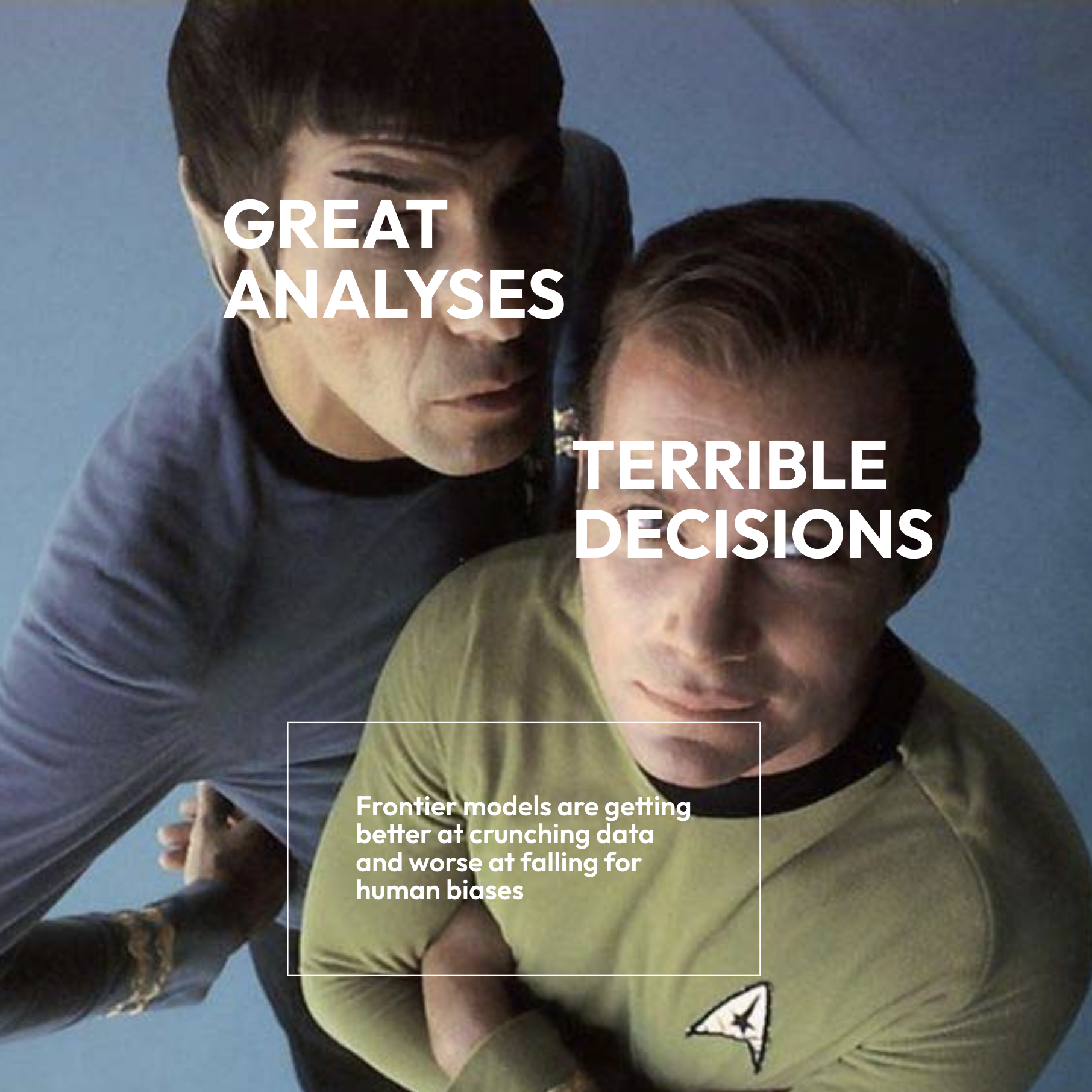
New NBER study just dropped that changes how you should think about the agents you're building into your business.
What they did:
Researchers ran the most comprehensive behavioral economics test on AI to date—16 experiments originally designed to document human irrationality, applied to 12 frontier models across GPT, Claude, Gemini, and Llama families.
Same tests Kahneman and Tversky used to prove humans violate Expected Utility theory. Loss aversion. Probability weighting. Hyperbolic discounting. The classics.
What they found:
Advanced LLMs exhibit a split personality.
On belief-based questions, like probability calculations, forecasting:
Models get MORE rational as they scale up.
Gemini 1.5 Pro answers 100% correctly.
On preference-based questions, like actual decisions:
Models get MORE irrational as they scale up.
Claude 3 Opus makes human-like irrational choices on 4 of 6 tests.
Bigger models = better math, worse choices.
GPT-4 can calculate expected utility perfectly.
But, if you frame the same bet as a loss instead of a gain?
It reverses its decision.
Just like retail investors do.
Why this matters for business:
AI doesn't have a bias problem.
It has YOUR bias problem.
RLHF—the training process that makes models helpful—taught them human preferences. Including our preference for irrational decision-making. Your $200M AI deployment just inherited loss aversion from Reddit, probability weighting from financial forums, and hyperbolic discounting from Twitter.
Three implications:
Don't automate decisions without human review.
Your AI can analyze perfectly but choose poorly—same as that brilliant analyst who blows every strategic call.
Test for biases, not just accuracy.
The model that scores highest on benchmarks might make the worst business decisions.
Design your guardrails accordingly.
Simple role-priming ("act as a rational investor") reduces biases by 4%. Detailed de-biasing instructions? Make it worse. Information overload breaks AI decision-making just like it breaks yours.
We're scaling intelligence and irrationality simultaneously.
What decisions are you letting AI make without checking for cognitive biases?
—
Source: Behavioral Economics of AI: LLM Biases and Corrections, Bini et al, Jan 2026
AI is getting smarter at math but dumber at choices.
Previous
Previous
Why is your AI so stuck?
Next
Next