
If your team were locked in a capsule for months, would anyone survive?
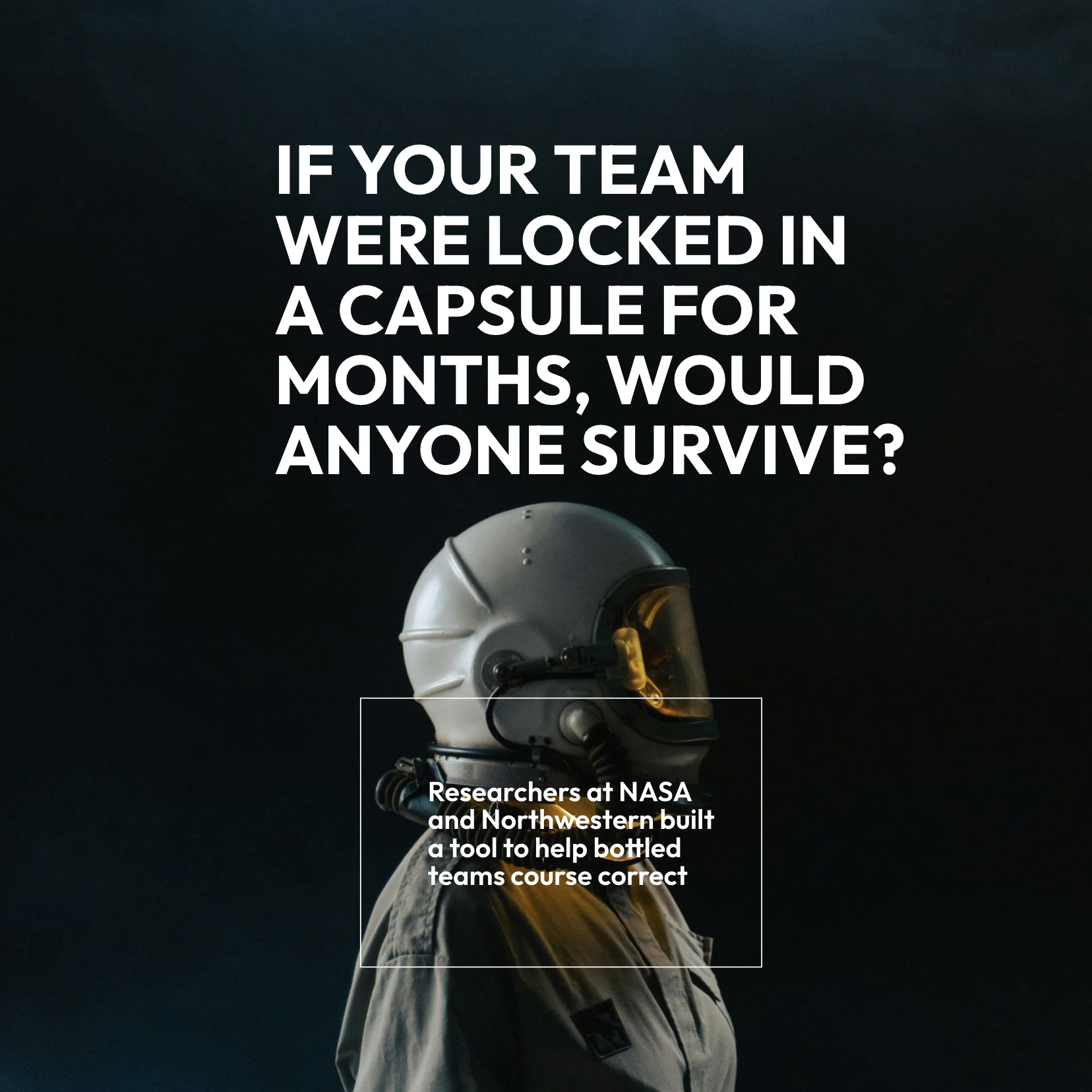
Here's the weird thing about teams locked in a room together for months:
They get better at the tasks they trained for. And worse at everything else.
Northwestern researchers spent nearly a decade studying NASA's simulated Mars missions—12 analog missions where crews lived sealed together for up to 8 months.
No breaks.
Over holidays.
Over kids' birthdays.
(The only time NASA stopped one was for Hurricane Harvey.)
The goal: figure out how a team survives a 3-year round-trip to Mars with no exit strategy and a 22-minute communication delay to Earth.
What they found upends a lot of what we assume about team-building.
Routine skills sharpen.
Creative thinking fogs.
As isolation wore on, crews improved at trained tasks—repairs, equipment control. But their ability to solve novel problems degraded. The collective brain fuzzed out over time.
NASA found that the best leadership structure is a fishing net.
Pick up one knot—temporary hierarchy forms.
Drop it and pick up another.
Expertise drives influence, not rank.
But when those leaders become adversarial? One 8-month mission fractured into competing factions after an early accident. That was worse than just having a single boss. Astronauts describe confined missions as "the perfect recipe for wanting to kill one another."
"Playing well with others" beats raw expertise.
The strongest predictor of performance wasn't cohesion or capability alone. It was balancing good vibes with accountability. You need both.
The researchers' solution: TEAMSTaR (Tool for Evaluating and Mitigating Space Team Risk). And, yes, that acronym needs to calm down. It’s a dashboard that lets crews forecast their own team "weather" and course-correct before things go sideways. Not for mission control to monitor them. For teams to regulate themselves.
—Shared cognition: Are we thinking and acting as one?
—Team viability: Are we able to work over and over again?
—Leadership dynamics: Are we able to fluidly claim and cede authority?
—Task affect: Are we emotionally gelling with each other?
—Hindrance: Are we holding each other accountable in productive ways?
What's the longest you've worked with the same tight team? What kept it from falling apart?