
No better than bank robbers
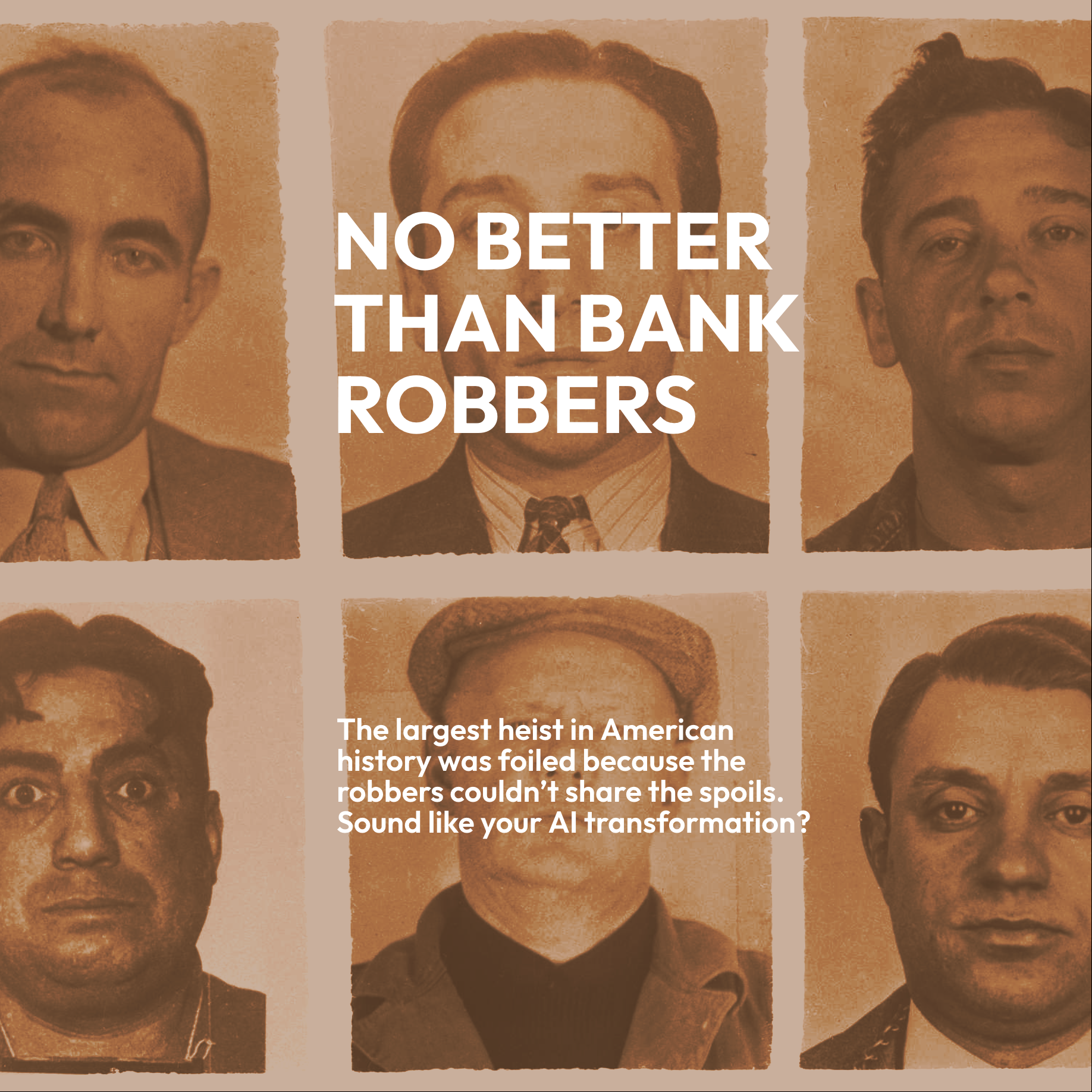
In 1956, the FBI foiled the biggest bank robbery in US history — just five days before the robbers would have gotten off scot free. They survived six years of the FBI, but they didn't survive each other.
On Jan 17, 1950, eleven men walked into the Brink's depot in Boston's North End wearing pea coats and Halloween masks. 35 minutes later, they walked out with $2.8 million (about $37 million today). They left a cap, some rope, and adhesive tape. No prints, no witnesses. The FBI chased ghosts for six years.
The gang's rules were simple:
Don't touch the money, don't get arrested, don't talk.
Ride out the six-year statute of limitations and walk free.
They almost made it. What broke them wasn't a detective. It was the split.
I see the same squabble today over who gets credit for AI gains. These fights don’t just poison one initiative, they kill the transformation that’s supposed to follow.
Specs O'Keefe got pinched on an unrelated burglary in Pennsylvania and had to leave his cut with another member of the crew. While he sat in jail, he started doing the math on what he was getting back versus what the others were spending. He wrote bitter letters. He hinted he might talk. So, the crew sent a hit man. When the hit man missed, O'Keefe walked into an FBI office and gave them every name.
Eight life sentences.
Five days from clean.
The hard part isn't the heist. Most companies have shipped something real — a working pilot, an hour reclaimed, a use case that proved out. The hard part is what happens next. Whose budget funded it? Whose org owns it? Whose scorecard gets the number? Everyone wants to own the transformation. So, everyone makes it clear just how much of the work was theirs.
That's the moment the transformation stalls.
Not in the build.
In the split.
McKinsey's 2025 State of AI report found that workflow redesign was the single strongest predictor of EBIT impact — and that high performers were nearly 3x more likely to have redesigned how work moves across functions. Any transformation that redesigns workflows also redesigns ownership. That’s the split.
The Brink's gang got to retire after one job. Transformation doesn't work that way. Every split teaches teams a lesson about who gets rewarded and who gets rolled. So, the second pilot is always harder than the first.
The heist isn't the hard part.
The split is.