
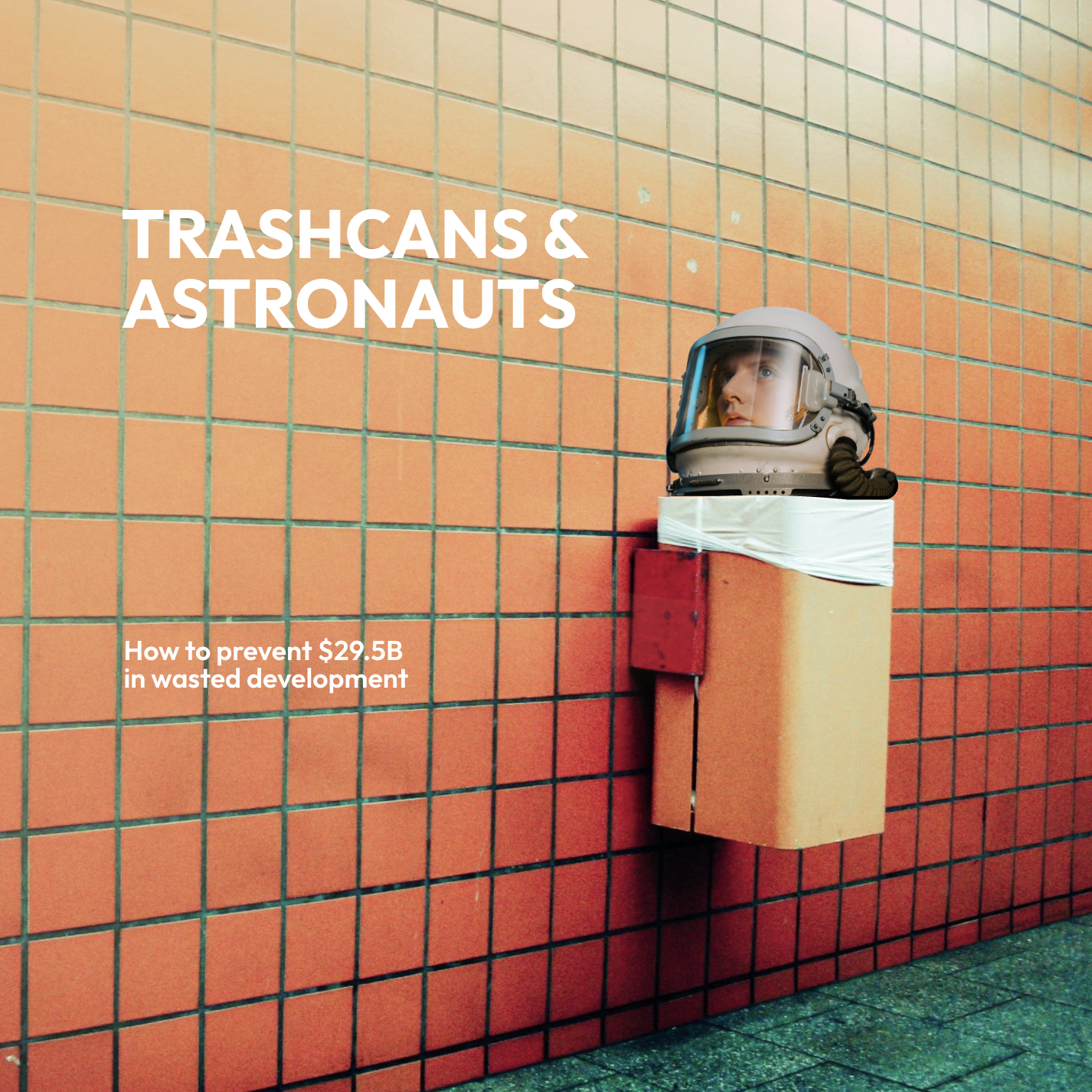
Trashcans & Astronauts
In 1961, an 11-year-old girl spent four days floating on a cork raft in the open Atlantic. No food, no water, no shelter from the sun.
The crew that finally found her said the hardest part wasn't the search area—it was spotting the raft. Neutral-colored equipment blended into the waves. A human being, drifting in millions of square miles of ocean, was nearly invisible.
That rescue changed everything. By 1962, the U.S. Coast Guard adopted "International Orange" as the regulation color for life equipment—a shade so vivid it doesn't occur naturally in any ocean, forest, or desert on earth. NASA later chose the same color for the suits astronauts wear during launch and reentry. Not because it looks good. Because someone watched a rescue nearly fail, and redesigned around what they saw.
That's design born from observation.
Walt Disney had the same instinct. Before Disneyland opened in 1955, he sat on a bench at other amusement parks and watched people. He noticed visitors carried their garbage about 30 steps before dropping it on the ground. Not because they were slobs—because that's how humans work when the infrastructure doesn't meet them. So he put a trash can every 30 steps. Then redesigned the can itself: enclosed, themed, invisible. Over a thousand of them in the park now. Most guests never notice.
Two completely different problems.
Same discipline: Watch real behavior.
Then build around what we actually see.
A study of 50,000 software projects over two decades and found the number one predictor of success was user involvement. Not the technology. Not the budget. Whether someone observed first.
Meanwhile, a 2019 study found 80% of software features are rarely or never used. That was $29.5 billion a year in wasted R&D. And that was before vibe coding existed.
Now 63% of vibe coding users are non-developers, the barrier to building has collapsed, and we're shipping faster than ever.
Speed is not the problem.
Building without watching is the problem.
And it was the problem long before AI showed up.
The tool has never been the hard part.
The sitting on the bench has.
—
Sources
Pendo Feature Adoption Report "The 2019 Feature Adoption Report," Pendo . io, 2019
Vercel State of Vibe Coding "The State of Vibe Coding 2025," v0 by Vercel, 2025
Standish Group CHAOS Report "CHAOS Report," The Standish Group International, published annually 1994-2020