
Your workflows are infinitely long
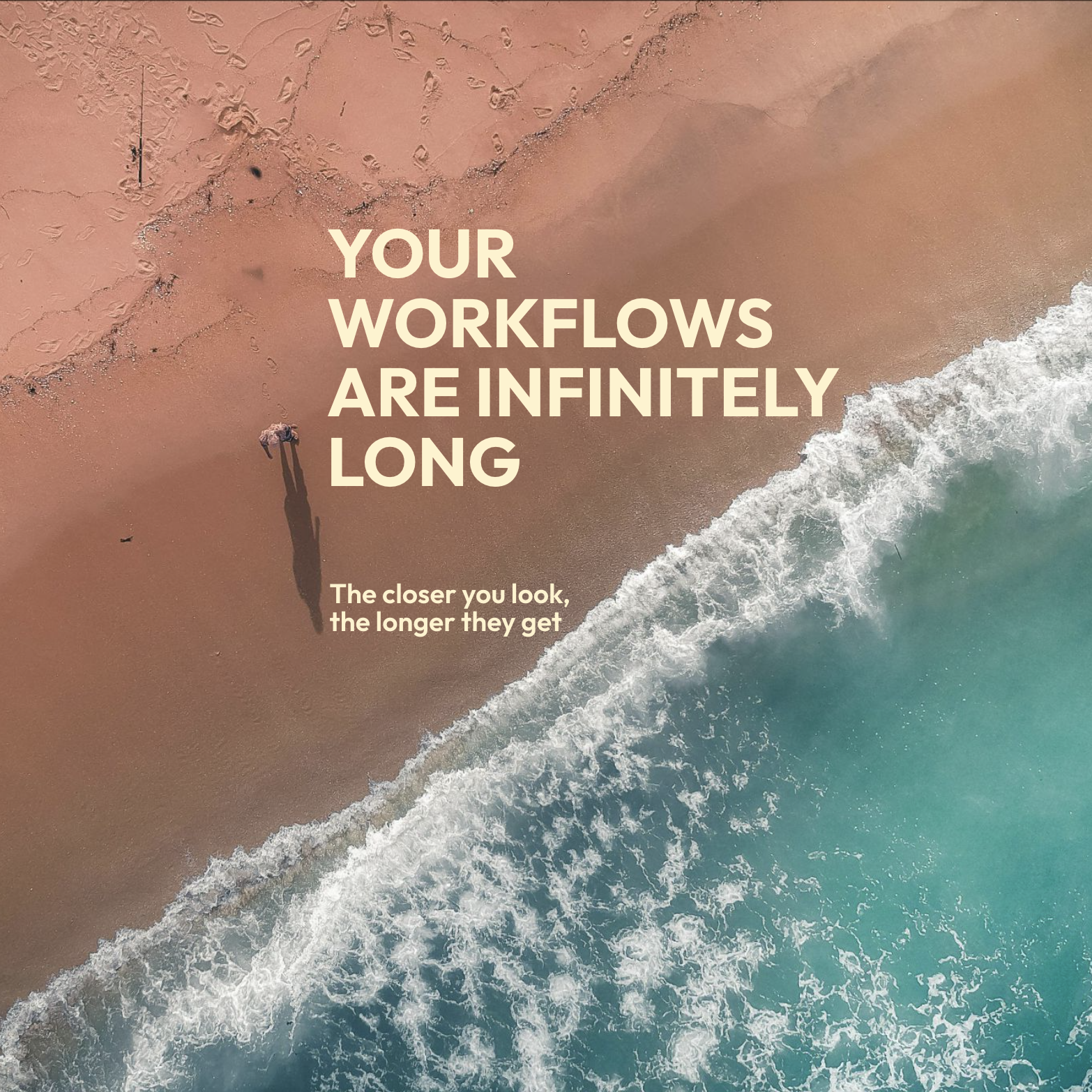
Spain measured its border with Portugal at 987km. Portugal measured the same border at 1,214km. Neither was wrong.
In 1951, mathematician Lewis Fry Richardson discovered why:
the finer your ruler, the longer the measurement.
Measure Britain's coast with 100 km segments? 2,800 km.
Use 50 km segments? 3,500 km.
Use 1 km? Over 8,000 km.
The closer you look, the longer it gets. Mandelbrot later gave it a name—fractals. Curves whose complexity never decreases, no matter how closely you measure.
I think about this every time a company tells me they're "mapping workflows" before deploying AI agents.
Because workflows are coastlines.
At the 10,000-foot view, your claims processing workflow is 12 steps.
Zoom in and it's 40.
Zoom in further—every exception, every workaround, every "oh but sometimes we do it this way"—and you're staring at infinity.
Companies spend months producing beautiful process maps that document the "should-be" state—how stakeholders believe things work. Not the as-is reality of how experts actually do the job.
The gap between those two things is where agents go to die.
The fix isn't mapping harder.
It's choosing the right ruler.
Start with the zoom level that matches your agent's job. Don't map the whole coast when you only need to navigate one harbor. Watch how your best people actually work. Not what the process doc says. Build agents on observed behavior, not documented fantasy.
Mandelbrot didn't solve the coastline problem by getting a better ruler.
He changed the question entirely.
That's what the best agent deployments do too.
I help teams figure out which harbors to navigate first—and which ruler to use. If you're stuck in infinite-map mode, let's talk.